What the car market will look like this year is as hard to forecast as any other market in “recession” 2023, but some things are moving in the right direction.
The new-car market in Serbia ended 2022 better than anyone expected, and this year will certainly be better still, because the starting position is now quite different.
“As we thought at the start of the year that it would be bad, last year ended quite well. Sales fell, but far less than they could have, given the general shortage of cars in production. By the end of the year the supply of cars was already better. What will remain a problem in 2023 is price,” Milan Belin, General Manager of Renault Serbia and a member of the Board of the Serbian Association of Vehicle and Parts Importers, told 24sedam.
In 2022 the Serbian market recorded a 10.5 per cent fall in sales compared with the previous year, which had been one of the better ones of recent times (growth of 14.4 per cent). With just over 24,528 vehicles registered for the first time, the result turned out solid in the end.
“For us it was more than solid, because in the end we managed to meet all our plans. It helped a great deal that we were able to obtain units of the newly presented Range Rover Sport, which was not easy. But we do not expect the market to stabilise in terms of vehicle availability in the first half of the year, and perhaps not in the whole of 2023. The question is whether, at least in the premium segment, we will return to being able to get a car within three months,” Stanko Čučković, sales director for Land Rover and Jaguar at British Motors, told 24sedam.
Prices will not run wild (any more)
Importers and dealers are not exactly rubbing their hands, but it could be said they have breathed a little easier. For drivers, that is, car buyers, the situation is somewhat different: the choice was narrower, cars were awaited for up to a year, and in the end prices rose by 10 to 60 per cent compared with December 2021.
“There will certainly be more cars on offer this year. Delivery times have already started to shorten and are no longer nine to 12 months. I already have vehicles that can be obtained from production in three or four months. As for prices, things are not so good. Cars are, I admit, too expensive, and I do not see prices calming down in 2023 either. The increases will be smaller than last year, but manufacturers’ costs keep rising. However, prices cannot rise indefinitely, because demand could then fall seriously,” Belin points out.
Čučković has a precise calculation too. The British flagships became 10 per cent more expensive on the Serbian market in 2022, less than December inflation, and they could rise by as much again this year.
Some wait for a new model, some fight for quotas
Importers and dealers of different brands in Serbia fared differently in the turbulent year 2022, depending on how, and at what price, they could obtain vehicles from their “parent” factories.
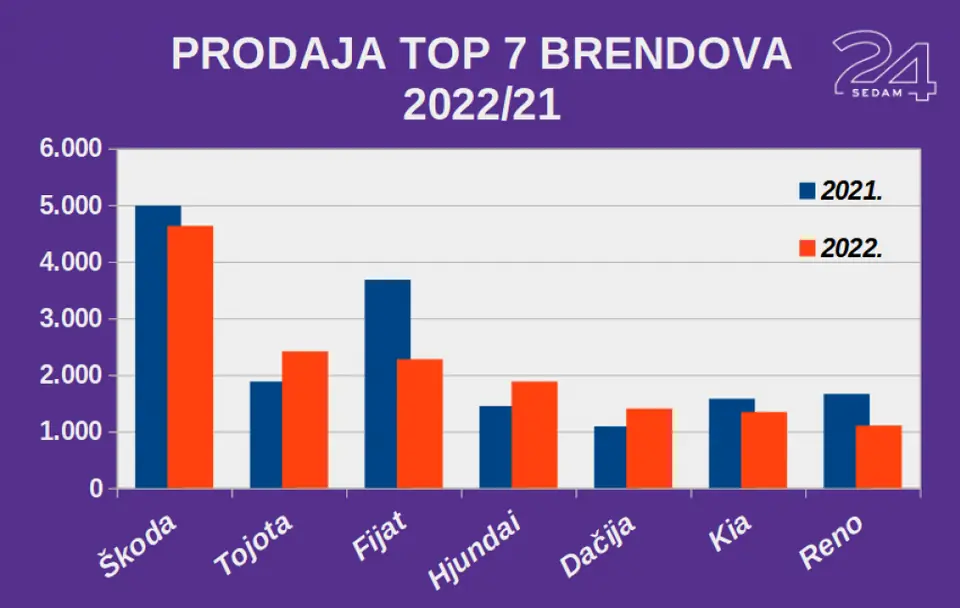
Among the seven best-selling brands, data from the analytics company Cube Team show that Toyota, Hyundai and Dacia saw sales jump by some thirty per cent. Škoda, which dominates the market, managed to limit last year’s difficult conditions to minus 7.2 per cent, while some, such as Renault and Fiat, fell by more than 30 per cent.
“Yes, it was not easy. Admittedly, we had a pause because of the reorganisation of Renault and Dacia, but we are ready to regain the market share we had in 2021. We have high expectations of the new Austral as the replacement for the Kadjar, and interest in Dacia is not easing, especially in the Duster 4×4,” Belin notes.
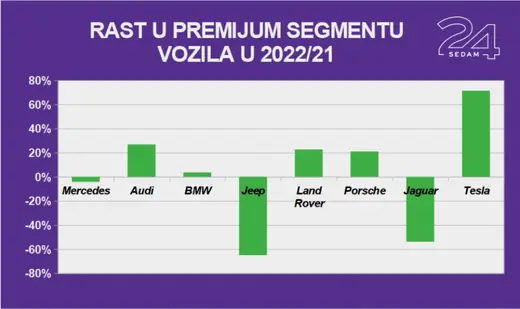
In the premium segment, too, some sellers could open the champagne to welcome 2023. Double-digit sales growth, above 20 per cent, was achieved by Audi, Porsche and Land Rover. As Land Rover and Jaguar have not planned new models for this year, British Motors is concentrating on something that worries it far more than the possibility of prices rising again.
“We are fully focused on obtaining larger vehicle quotas for our market from the manufacturer, in order to meet the needs of Serbian buyers,” Stanko Čučković concludes.
Source: 24sedam.rs